The Monolith

The Monolith

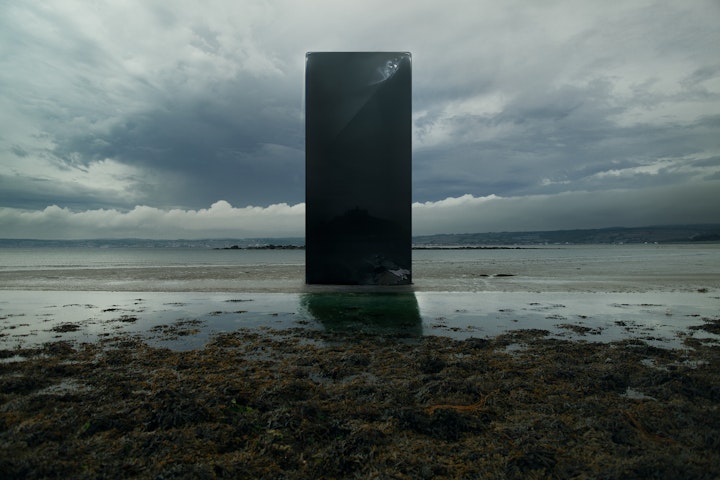
I had wanted to create a piece for a while that nods towards one of my favourite films; 2001, and the visual simplicity of the film’s Tycho monolith with its silent, constant presence is obviously a perfect starting point. This is the first of (hopefully) a set of three prints and illustrates the moment immediately following the tragic impact of a small body against the large, omnipresent object.

Unaligned Ideals
Unaligned Ideals Caption
Unaligned Ideals Detail
Unaligned Ideals Detail Caption

The first of (hopefully) a set of three prints; the base element of this image started life as a photo of my microwave. I’m not great with microwaves, infact i tend to blow them up, and this one was only three months old when it went.

The unit itself had a very nice unmarked, uncluttered mirror front, which, in its own right, was actually a great piece of produce design and something I didn’t want to commit to the dustbin without at least giving it an aesthetic eulogy. So, to cut a long story short, i took a hammer and smashed it up. Unexpectedly, the mirrored front was plastic and didn’t crack as i assumed it would, instead breaking like shatterproof glass into thousands of pieces all over my kitchen floor.

I had wanted to create a piece for a while that nods towards one of my favourite films; 2001, and the visual simplicity of the film’s Tycho monolith with its silent, constant presence is obviously a perfect starting point. The structure of the 2001 monolith is mathematically relevant with the three sides of the object following a strict ratio based on the squares of the first three integers (1, 2, 3). The monolith is officially described as having a ratio of 1:4:9 with the depth being the smallest of those integers, and the length being the largest. This is an expression of (1×1):(2×2):(3×3). However, researching around, opinion is divided and states that the monolith doesn’t actually conform to this ratio, but instead conforms to the ratio 1:4:13, which incidentally is the same ratio seen in the Montparnasse Tower in Paris. 2001 was released in 1968, construction on the Montparnasse Tower begun in 1969. However, i couldn’t validate that particular opinion over multiple sources, so my monolith follows the original 1:4:9 ratio (or at least, as a flat object, the 4:9 ratio).

My imitation of Kubrick’s Tycho monolith stops there though; it is glossy, has rounded corners and the piece itself illustrates the moment immediately following the tragic impact of a small body against the large, omnipresent object.

Loosely titled ‘The Only Conceivable Outcome of Two Unaligned Ideals’ the piece is an exercise in appreciating the fragility of small things, that no matter how insignificant the latter may appear to the former, every encounter leaves its mark.

The original piece is 75x100cm (9000x12000px), which is also the biggest digital canvas i’ve ever tried to work with, and unfortunately doesn’t show particularly well as a small grab on a site like this.

Leave a Reply

Brunswicker


I just want to quickly illustrate Mark Brunswicker’s work on The Vision Paper. Great use of type over imagery and really messing about with the grid creates a sophisticated layout where the editorial appears to float over the page. At once constrained, but delightfully capricious.

Read more.

Ben Jeffery

Leeds-based graphic designer Ben Jeffery has an incredible eye for layout and has recently worked with Rankin on his newest magazine project The Hunger. In all of his projects you’ll find a well considered, incredibly tight presentation that effortlessly communicates the editorial in as minimal and achingly sharp method as i think its possible to produce.

Read more.

Riitta Paivalainen

Riitta produces ghostly psuedo-sculptures by wrapping linens around, and arranging clothing in, trees and scrub. By presenting her work as photographs she can use the environment she’s working with as part of her piece, giving her sculptures an environment within which to live; suggesting the passing passage of time and a record of events that have already happened.

Read more.

Monolith 2

This beautiful photo was shot by James Cambourne at Saunton, between Exmoor and Dartmoor on the coast. The original has been beautifully graded down and is presented in very wide 2.35:1 format. Taking the original photo, and another from the same set to work into the Monolith’s reflection, i’ve kept faithful to James’ grade but have had to slightly increase the height to display the Monolith fully.

Read more.

Neil Kellerhouse

Graphic designer Neil Kellerhouse is responsible for some of the most arresting and important movie posters in recent years. Based in Los Angeles, Kellerhouse has spent the last year working with directors such as Fincher and Soderbergh.

Read more.

Feric

I bought one of Feric’s red-crowned crane prints a couple of years ago; a whimsical and elegant take on using engineering drawing practice in a very original way. And since then Feric has been busy…

Read more.

DepotVisuals

Modelling digitally with reference to real-world materials like plastics and wood, German studio DepotVisuals build informational installations and imagine constructs that are just slightly too perfect and too whimsical to exist in the real world. Amazing stuff. Take a look at their work.

Read more.

520 Ways To Say I Wish You Were Here

For her birthday late last year i created this poster for Shon; it is the dialogue from my phone of the few text messages that went into arranging our first date, then the first month of our relationship afterward.

Read more.

Carol Prusa

American artist Carol Prusa works with acrylic globes and domes, illustrating incredibly detailed mathematical structures on a unique and subtly three-dimensional construct. Take a look at her portfolio of work.

Read more.

The Monolith

I had wanted to create a piece for a while that nods towards one of my favourite films; 2001, and the visual simplicity of the film’s Tycho monolith with its silent, constant presence is obviously a perfect starting point. This is the first of (hopefully) a set of three prints and illustrates the moment immediately following the tragic impact of a small body against the large, omnipresent object.

Read more.

Profission Circles

Back in 2004 whilst at Kleber I was asked to create a site for Italian composer and producer Ferdinand Arno, promoting his studio; Quiet, Please! The concept had a special pre-requisite – the site was to have no descriptive words at all, so we’d need to look at an alternative way of communicating the concept. What started with that concept then evolved a couple of times over the next few years!

Read more.

Digital Temple

French agency Art Noble’s excellent Digital Temple magazine reaches its 11th issue and transcends from online publication to a fully realised print release – not an easy thing to achieve in the current climate. So, that is great news indeed. The magazine can be pre-ordered here.

Read more.